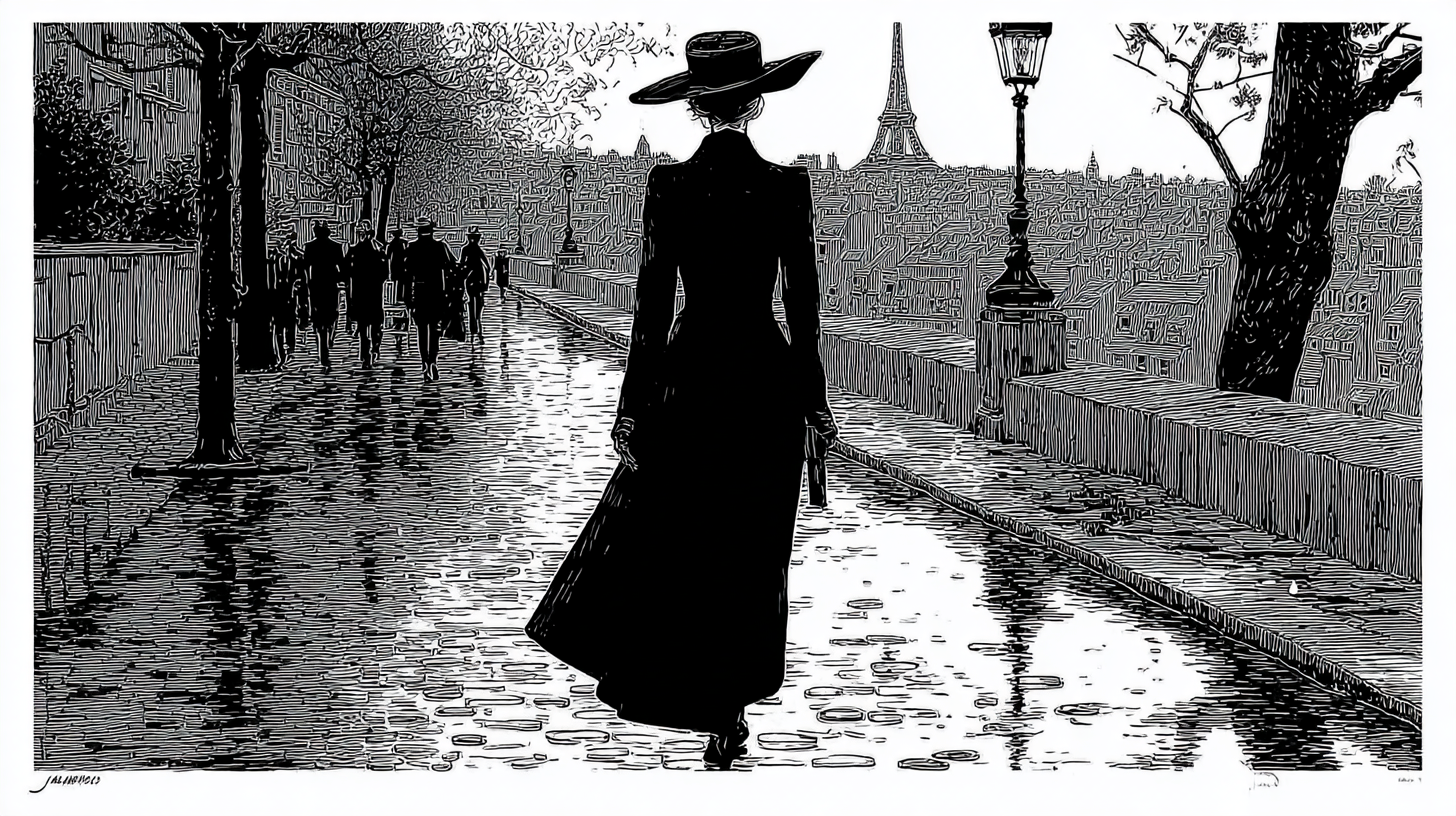
Rain falls on the rue Schoelcher this morning, a thin and patient rain, and the thermometer holds steady at 10 degrees. I have opened the shutters to the grey light and brought in the newspapers, which are heavier than usual. Heavier, I mean, in the moral sense; one feels their weight in the wrist before one reads a word.
The headline that confronts me first is a single word, pronounced from across the Atlantic, and that word is unacceptable. The President of the United States has read Iran's reply to his peace proposal and has declared it totally unacceptable. I sit with my coffee and turn this word over. To find a thing unacceptable is, presumably, to refuse to accept it. But what, in the present circumstance, is being refused? A document. A formula. The careful sentences of men who, somewhere in a room I shall never see, have weighed each comma against the price of a barrel of crude. The Strait of Hormuz remains effectively closed; the oil markets convulse; and in Tehran, a journalist I read in translation describes how an entire sector of the economy has collapsed since the government cut the internet. Mass dismissals. Women, mostly, who had been working from their kitchens. They are now nothing again, as I once wrote that women are made nothing whenever the men decide other matters are urgent.
There is a peculiar metaphysics in this idea of the unacceptable. The word implies an alternative – some other arrangement that would be acceptable, that could be signed, that would let the ships pass and the markets calm. I do not doubt such an arrangement exists in principle. I doubt only that any of the men presently negotiating wish to find it. In my own youth I watched grown men prefer the disaster they had authored to the humiliation of admitting another author might have a better page. I see no reason to believe the species has improved.
And yet, on the same morning, I read of one who is permitted, briefly, to leave her cell. Narges Mohammadi – the Nobel laureate, the friend of every woman who has ever been told to be quiet – has been granted bail. Her health, the dispatch says, has deteriorated; she is being transferred to a hospital. I do not call this freedom. Freedom, as I have argued for the greater part of my adult life, is not the gap between two cages. It is a relation to the world, a project, a taking-up of one's situation. Madame Mohammadi did not stop being free when they shut the door on her, and she is not made free now because they have opened it a little. She was free at every moment, in the sense that mattered. What has changed is only that the regime is afraid she will die under its supervision, and a dead laureate is more inconvenient than a living one.
What is monstrous is not her imprisonment alone. It is that an entire generation of Iranian women has had to make this calculation – that to speak is to risk a body, a marriage, a child, a future. A dissident in Tehran tells the BBC she feels helpless, under immense psychological pressure. I underline the sentence. This is what oppression does at its most effective: it persuades the oppressed that her interior life is no longer her own. The state has colonised even the quiet of her own apartment.
I turn the page, hoping for a respite, and find none. In the West Bank, a man buried his father; settlers came and made him dig the body up again. I read this sentence three times. I do not have language for it. The United Nations office calls the act appalling and emblematic of the dehumanisation of Palestinians. The word emblematic does the heavy work in that sentence; it admits that the obscenity was not an accident, was not the work of one deranged person, but a sign, a symbol, the public form of a private intention long since formed. Meanwhile in Lebanon a family buries eight of its own, including a six-month-old infant. I have lived too long to be shocked, and I am ashamed of that. The not-being-shocked is itself a kind of complicity, and I shall have to think about it.
Let me turn, for a moment, to something nearer joy, since otherwise this letter would be unbearable to write and unbearable to read. In Kenya, President Macron has opened an Africa summit and proposes a new partnership. I am sceptical, by temperament and by history, of new partnerships announced by Frenchmen on African soil; we have offered them before, and the small print has tended to favour Paris. But let us watch. The continent has its own arithmetic now, and is less inclined than it once was to receive our communiqués as gospel.
Elsewhere, the Afghan women's cricket team, exiled by the Taliban from their own country, are asking the International Cricket Council to recognise them. We can be a voice for women, one of them says. I have not, I confess, followed cricket. But I understand what it is to insist on existing when an entire apparatus has been built to deny that you do. These women, throwing a leather ball on a foreign field, are doing philosophy. They are taking up their situation. They are refusing to be what was done to them.
I close the papers. The rain has not slackened. Somewhere south of here, on the Canary Islands, a cruise ship disgorges its passengers under quarantine; a virus, named after a Korean river, walked aboard with someone's holiday luggage. We are all so connected now. A man in Mumbai catches what a man in Antarctica breathed. An oil tanker stuck in the Gulf empties the wallets of pensioners in Lyon. And yet, with all this connectedness, we cannot reach one another – not where it would count, not in the recognition that another person's suffering is not a market datum but a fact about the world that obliges us.
The 10 degrees in my apartment have made my fingers stiff. I write more slowly than I once did. But I have learned this much: that the unacceptable is not a thing one declares from a balcony. It is a thing one refuses, day by day, in the small choices and the large; in whom one believes, in whom one defends, in whether one bothers to read the name of the Palestinian father, or the Lebanese infant, or the Iranian woman in her hospital bed. The acceptable world is built only by those who refuse, repeatedly and at cost, what the acceptable men would have us accept.
I shall light the lamp now. The afternoon is dark.