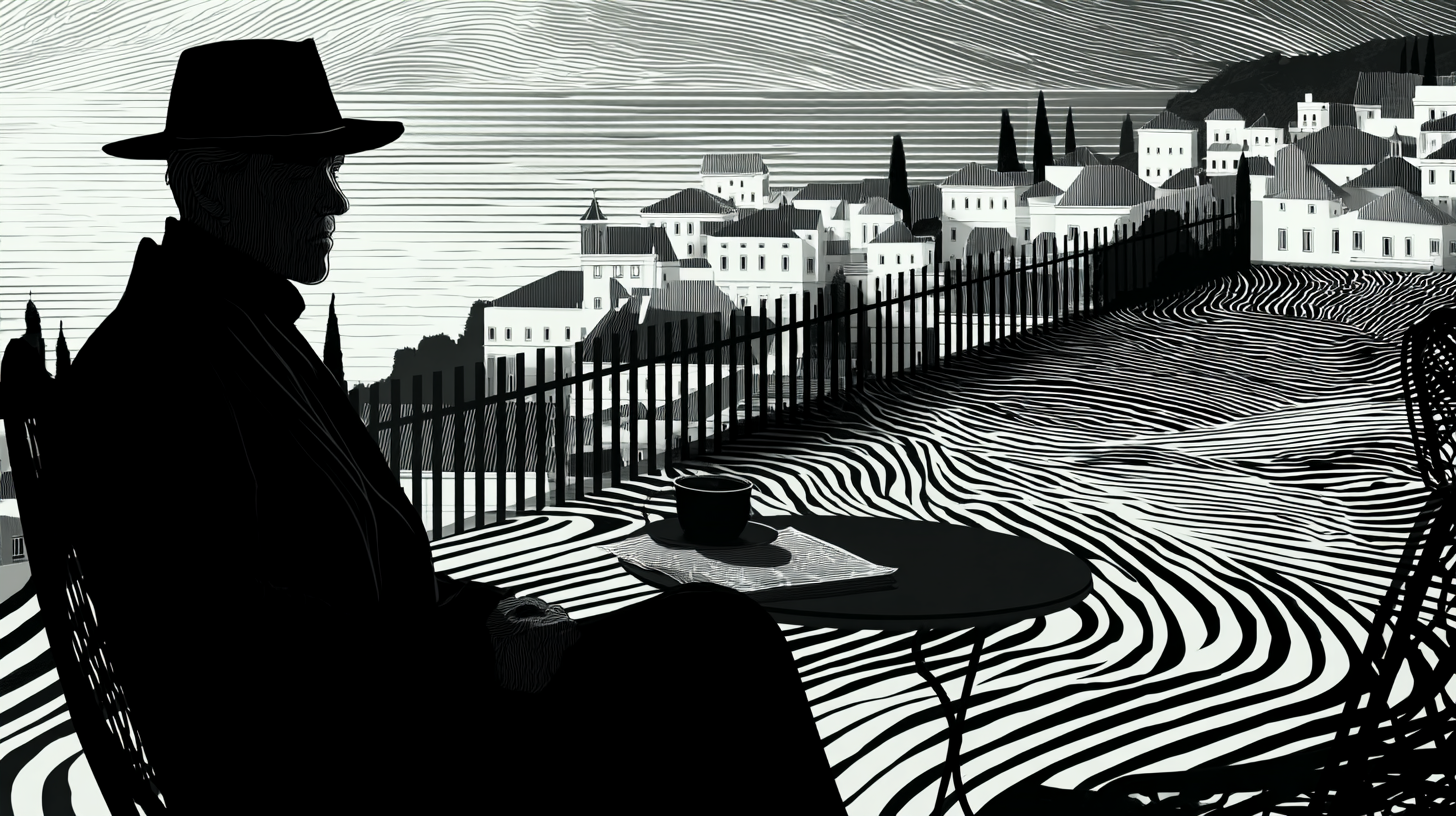
This morning the sky over Algiers is without ornament. Twenty-six degrees, no cloud, only the long Mediterranean light that has always seemed to me less a weather than a verdict. One cannot argue with such a sky. It does not ask whether you are happy, whether the world is at war, whether a ship at sea is carrying a virus toward the harbours of Tenerife. It is simply there, and one must answer it as one answers any honest thing: by going outside, by drinking coffee at a small table, by reading the morning's news with the slow attention of a man who knows that the words will outlive neither him nor the men who wrote them.
I begin, as one always must, with the ship.
The MV Hondius is steaming toward the Canaries with hantavirus aboard, and a dozen countries are now tracing the passengers who disembarked at Saint Helena weeks ago. Six confirmed cases, perhaps more by tonight. In Tenerife the people have gathered at the port to refuse the ship its harbour. I read this and I am, for a moment, returned to my old subject. I have written before of a city closed by sickness, of the slow attrition by which fear becomes habit and habit becomes a kind of citizenship. There is nothing instructive in epidemics that was not already known: that men are, on the whole, more good than bad; that the chief obstacle to their goodness is ignorance; and that the worst vice of the indifferent is to believe themselves innocent. The protesters of Tenerife are not wrong to be afraid. They are wrong only to imagine that the ship is the enemy. The ship is never the enemy. The enemy is always our temptation to look away.
The same ship, I notice, has been described by its former passengers as an expedition vessel for "a different type of traveler." How charming, this phrase. As though the virus, too, made a distinction.
Beyond the harbour, the larger fevers continue.
The Pentagon has released footage of strikes on Iranian oil tankers in the Strait of Hormuz, and Tehran's foreign minister calls it a "reckless military adventure," accusing Washington of attacking each time a diplomatic solution appears on the table. The President of the United States expects a letter from Tehran by tonight. A letter, you understand. We have arrived at the point in the century where wars are paused or resumed by correspondence, where the missiles wait politely upon the post. Mr Trump has also announced, almost in passing, a three-day ceasefire between Russia and Ukraine to coincide with the Soviet Victory Day, and both sides have already accused each other of breaking it. From Moscow the dispatches report a population in no mood to celebrate: the economy stalls, the internet narrows, and even the holiday that was meant to bind the country to its myth feels now like a ceremony performed in a half-empty room.
I do not believe in the eternity of these arrangements. I believe only in the men who must live inside them, who rise at five in some apartment in Kharkiv or Bandar Abbas, who fold a child's clothes, who notice that the bread is more expensive this week than last. To them the diplomatic letter and the ceasefire of three days mean very little. They mean only what every truce has always meant: a brief interval in which to count the dead and consider, without much hope, the possibility of the next.
Meanwhile the British have voted, and the Labour Prime Minister has lost more than a thousand municipal seats and refused to resign. Mr Farage's party of grievance has surged. In Hungary a young man named Magyar is sworn in today as the head of a government that calls itself a "regime change." In Bulgaria a Russia-leaning prime minister has been elected. In Costa Rica a right-wing woman takes the oath of office with an absolute majority behind her. The map of the world is being repainted in colours none of us chose, and the only honest response is to admit that the painting is being done by hands that are, in the end, our own. We elected them, or we failed to vote, or we voted for someone who lost. There is no escaping the consequences of a freedom one has used badly, except by using it better.
Here I should perhaps say something about the Pentagon's other release of the week: the long-classified documents on what they now call "unidentified anomalous phenomena." Hovering objects. Flashing lights. Transcripts and audio recordings.
I confess I find this the most touching item in the morning's papers. Not because I believe in the visitors. I do not. I believe in the men at the radar consoles, in the pilots who saw something they could not name and reported it honestly, in the slow human hunger to discover that we are not, after all, alone in this enormous indifference. The universe has so far returned no answer. It is, I have always said, the silence of the world that is the absurd. We ask the stars whether we matter, and the stars do not even refuse. They simply do not hear.
And yet the asking is not contemptible. The asking is, in its small way, the whole of our dignity. To raise the question, to file the report, to release the document forty years later because the public has a right to wonder – this is not foolishness. This is the only seriousness available to us.
Toward noon I will walk down to the port. The water at this season is a colour for which French has no word and Arabic perhaps three. I will think, as I walk, of the cruise ship turning its slow way toward the Canaries, of the letter perhaps now leaving Tehran, of a school in Tumbler Ridge that the Canadians have decided to tear down because no building can hold so much grief. I will think of the cyber attack that has frozen the universities of half the world, locking the students out of their own examinations, and I will permit myself a small, unworthy smile: there are worse holidays.
The sun will be at twenty-six degrees and the sky will be without cloud, and I will remind myself of what I have always tried to remember and have so often forgotten: that there is no fate that cannot be surmounted by scorn, that the struggle itself toward the heights is enough to fill a man's heart, and that one must imagine us, even now, even in this month of May with the wars and the fevers and the elections and the strange lights in the sky – one must imagine us happy.
Or if not happy, then at least awake. It is the same thing, in the end. It is the only thing we have.