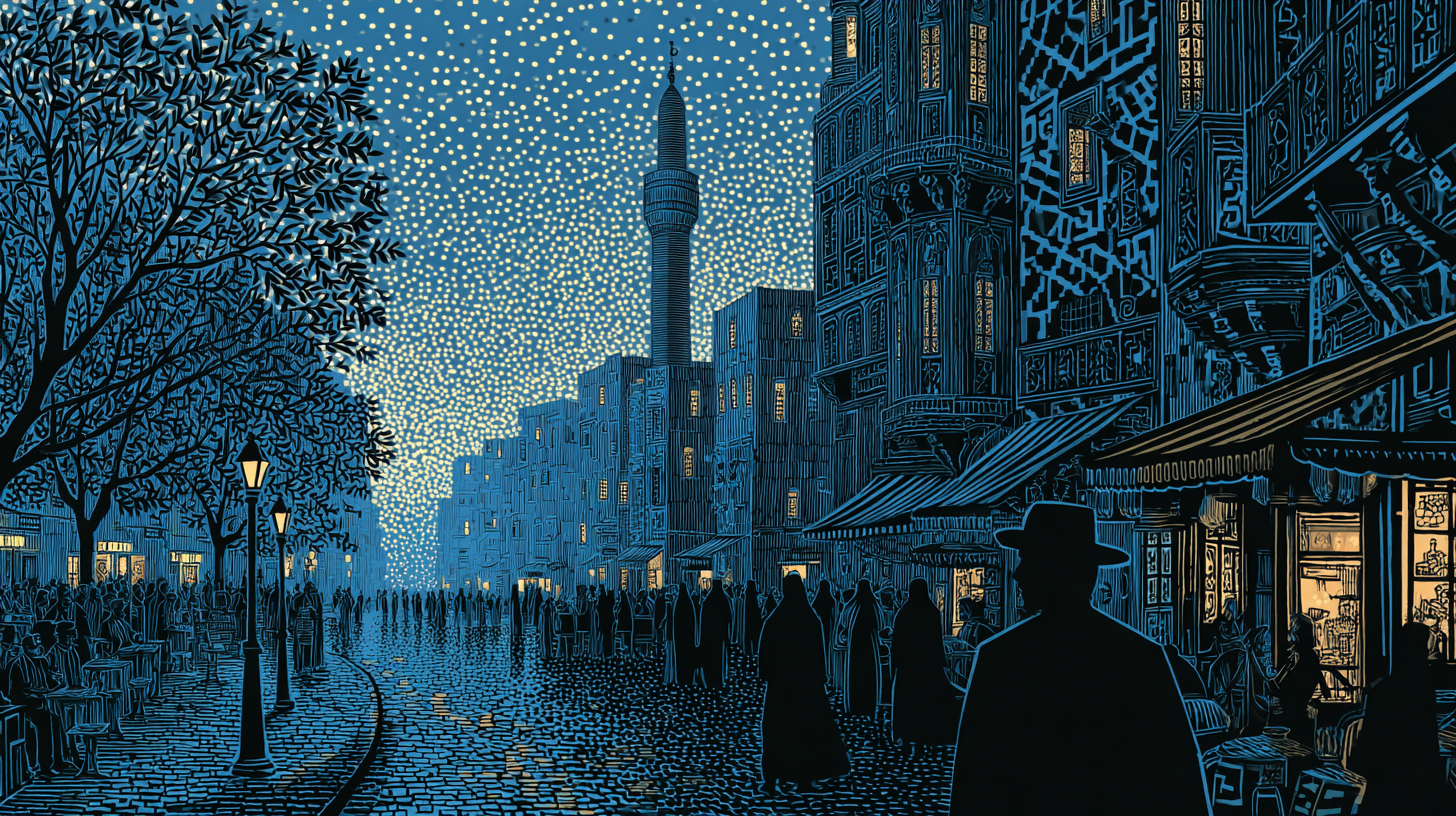
The light came down thinly over Khan al-Khalili, fourteen degrees by the thermometer above the pharmacy, and Sayyid Abd al-Hamid pulled the wool of his collar a little closer to his throat as he turned the corner into the alley of his usual café. The sun was a clear sun, not yet warm but already certain of itself, and it struck the brass trays of the souvenir vendors with that particular Cairo brilliance which compels even the disenchanted to lift their faces toward it. The boy at the door of al-Fishawi greeted him by name, as he had every morning for thirty-one years, and asked whether today the effendi would take his coffee mazboot or with less sugar than the world deserved. Sayyid laughed, a brief laugh, and said: today the world deserves nothing.
He sat at his customary table, between the mirror that no longer remembered which face it had first reflected and the window through which a slice of sky was visible above the spice market. The newspapers were folded, in their usual little pyramid, and he opened them without haste. There was time. There was always time. That was the difference, he sometimes told himself, between Cairo and the cities of the impatient.
The first headline announced that the American president had paused his operation in the Strait of Hormuz; that something called Project Freedom had been begun on Monday and abandoned by Wednesday in the hope of an agreement with Tehran. Sayyid read it twice, then a third time, and shook his head with the slow satisfaction of a man who has lived long enough to know that the names empires give to their gestures matter less than the gestures themselves. Project Freedom. Forty years ago they had called another such operation by another such name, and the ships had sailed in, and the ships had sailed out, and the Gulf had remained the Gulf. The Iranian foreign minister was now in Beijing; the Saudis and the Emiratis, his neighbours across the desert, were quarrelling over their oil quotas as cousins quarrel over a shared inheritance; the Americans, having declared their offensive complete, were now seeking what their secretary called a face-saving compromise. Faces, Sayyid murmured, had become very expensive lately.
The waiter brought the coffee in its small porcelain, and behind him came the smell of cardamom from the kitchen, and behind that the call to prayer from the minaret of Sayyidna al-Hussein, soft, a cloth laid over the noise of the city. From the radio at the back of the café a voice was reading, in cool diplomatic Arabic, that the Japanese minister of trade had concluded meetings with the Saudis and the Emiratis to secure the steady arrival of crude. So the Far East worried about its lamps, and the West worried about its ships, and Cairo, as ever, sat in the middle and drank its coffee.
He turned the page. A Brazilian schoolboy had killed two of his teachers; a German citizen had driven his car into a crowd in the city of Leipzig and left two dead behind him; in a fireworks factory in China twenty-six souls had been scattered into the air which they had spent their working lives setting alight. He read each item slowly, as one offers a small prayer for the unknown dead, and folded that page face down, because there is a limit to what a man may take in with his first cup.
Some news, however, was of a stranger order. A cruise ship in the Atlantic, struck by a virus carried by mice, had been refused harbour by one country and was now permitted to limp toward the Canary Islands; three were already dead, and the rest of the passengers were sailing through their ordinary holiday under a banner of quarantine. He pictured them – the German retirees, the English honeymooners, the Spanish grandmothers – leaning at the rail under a clean flag, watching the ocean and not knowing whether the ocean watched them back. Quarantine was an old Cairene word, he reflected. The city had borrowed it long ago from the Italians who had borrowed it from the Black Death; in every generation since, there had been a season when the doors of certain houses were marked. The marks change; the season returns.
He sipped his coffee. The radio reported now that Mr. Modi had triumphed in the elections of West Bengal and was, in the analyst's careful phrasing, closer than ever to the dream of an India without opposition; that the Romanian prime minister had been deposed by a coalition of his own ministers with the far right; that an Indian film star named Vijay had swept the polls in Tamil Nadu by being, in the words of the broadcaster, fun. Sayyid considered this last word for a long moment. Fun. So that, too, had become a qualification for governance. Once it was wisdom, then severity, then competence, then charisma, and now fun. In the long room of history, he thought, the doors keep adding themselves at the back.
A boy came around with the lottery tickets and was sent away gently, as he was every day. Sayyid took out his small notebook and wrote, in the careful hand of a man trained under the British: The world rearranges its furniture, but the room stays the same. He had been writing such sentences in such notebooks for fifty years. Some of them he had even meant.
Outside, the alley filled. A woman in a long abaya passed, holding the wrist of a child who looked up at the swallows above the minaret. A foreigner, lost, asked the boy at the door for the way to the Sultan Hassan mosque, and the boy pointed and laughed. Above the rooftops the sun climbed; the fourteen degrees crept upward by a slow degree; the café smelled of tobacco and orange peel and the small green plant which the owner watered each morning with the patience of a man who believed in plants.
The last paper carried a smaller item, near the bottom of an inside page. A comet had been seen, faintly, over New Zealand and Australia and the Cape of Good Hope. Its name was a string of letters and numbers, but it had come, the article said, from the Oort cloud, that distant haze of ice at the edge of our solar arrangement, and would not return for many thousands of years. Sayyid read the item twice. Then he closed the paper and looked through the window, past the rooftops, past the minaret, into the patient Egyptian sky.
So, he thought. The Americans pause; the Iranians travel; the ships drift; the cities shake; cousins quarrel over oil; an island in the Atlantic prepares its harbour for a sick ship; and somewhere, faint as a thought one almost remembered, a piece of light older than every empire draws its slow line through the southern sky. He raised his cup to the sun on Khan al-Khalili, fourteen degrees, perfectly clear.
May the day be kind, he said, to no one in particular, and the city, as ever, went on about its business of being itself.