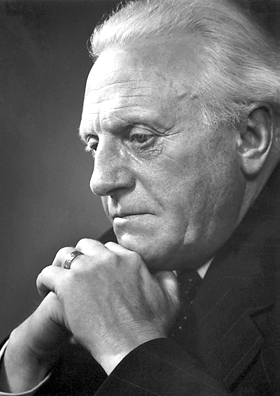
The rain has come again to Växjö. It falls on the lake and on the slate of the church, and on the shoulders of a man who walks home in the dusk, neither hurrying nor slow, because there is no shelter that will keep out the news of the world. Nine degrees, and the cold is in the wood of the bench by the water, and in the breath that hangs a moment before it disappears. He stops to listen. He has always listened. A man learns nothing by speaking.
In the Strait of Hormuz the great ships are caught between two shores. They lie at anchor with their cargo of oil, their crews of men who did not ask to be where they are. A president across the ocean has named an operation Project Freedom, and the word has gone out that the warships will escort them through the narrow water. Iran says any interference will break the ceasefire. The world's markets have looked at the news and shrugged. Brent crude is unmoved. The price of a man's life is not what it was, perhaps. Or perhaps it is what it has always been, only now we are honest about it.
He thinks of the strait. How a strait is not a sea, but the place where the sea is forced to remember that it cannot go everywhere. Every life has its strait. Every age has its strait. There are men this evening who lie in their bunks and listen to the engines and to the silence between them, and wonder which they fear more.
There is a ship in the Atlantic from which three are dead. A husband and a wife, elderly, who had thought to see the open sea once more before the end, and a third whose name has not been given. Hantavirus, the doctors say. A virus carried by rodents. A thing that lives where men do not look. The ship sails on, because a ship cannot stop in the middle of the ocean, and three more passengers lie ill in their cabins, and one is in intensive care. Six souls who paid for the voyage and now pay something else.
This is the matter that has always troubled him. That a man may set out in good health, with his suitcase packed, with his ticket in his hand, and still arrive at a place he never bought passage to. The unseen has its own itinerary. We sail and the sea sails differently.
In Morocco two American service members are missing. They were on exercises near a town called Tan Tan, and now there is a search and rescue, which is the polite name for the hope that something can still be found. Their mothers do not yet know whether to grieve or to wait. Both are difficult. Waiting is perhaps the harder. To grieve is at least to know.
In Upper Austria, in a forest, five children gathered wood and built a fire. They were ten and eleven and twelve and fourteen, the age at which one believes the world is solid. Beneath the wood lay a relic of a war that ended before their grandparents were born. The fire warmed it. The relic remembered what it was for. All five were carried to hospital.
He puts down the paper. The rain on the window is steadier now. He thinks: the dead do not always lie still. We bury them, and our wars, and we tell the children the ground is safe. The ground is not safe. The ground keeps its own counsel.
In Iran a woman who won the Nobel Prize for Peace has been taken from her cell to a hospital, and her brother fears she is dying. She is fifty-four. He has not seen her in years. He says her health has collapsed. There is something terrible about a peace prize given to a person whose government will not let her be at peace. The world honors what it will not protect. This too is a strait. The shores are very close.
In Ukraine, ten more were killed by Russian missiles in a single day. President Zelensky says his country has struck back at the shadow tankers that carry the enemy's oil. The shadow fleet, they call it, the ships that move without flags, that exist and do not exist, that the sea does not officially carry. The war is now three years deep, and the shadow has grown long enough to cover everything.
In a field in France near Bourges, on a military firing range, forty thousand young people gathered for what they call a free party. They danced until dawn on ground designed for the rehearsal of killing. There is something in this that he cannot dismiss as foolishness. The young have always known what their elders pretend not to know: that the firing range is exactly the place to dance. If one waits for safe ground, one will never lift one's foot.
He thinks of them, the boys and girls in the wet grass, with their music and their pills and their bright trembling faces, and he does not condemn them. They are doing what the soldiers also do, only without the lie. They have come to the place where men prepare to die, and they have chosen instead to be alive there, briefly, deafeningly, for as long as the night will hold.
A Spanish prime minister's plane has made an emergency landing in Turkey. He is unhurt. The plane came down where it could. This is what one does. One comes down where one can.
The rain continues. It is not a hard rain. It is the patient rain of the Swedish spring, that does not announce itself and does not stop. He pulls his coat closer. Nine degrees, and the lake is the color of old pewter, and the bells of the cathedral mark some hour or other, he no longer counts.
He thinks: the news is always the same news. The names change, and the straits change, and the rodents and the wars and the children gathering wood. But the question is the same question, and we have not answered it, and perhaps we will not. Perhaps the answering is not what is asked of us. Perhaps only the standing in the rain is asked, and the listening, and the refusal to look away from the small, obstinate, breakable bodies that move through the narrow places in the dark.
He turns toward home. There is a light on in the kitchen window. Someone is waiting. This is, for tonight, enough.