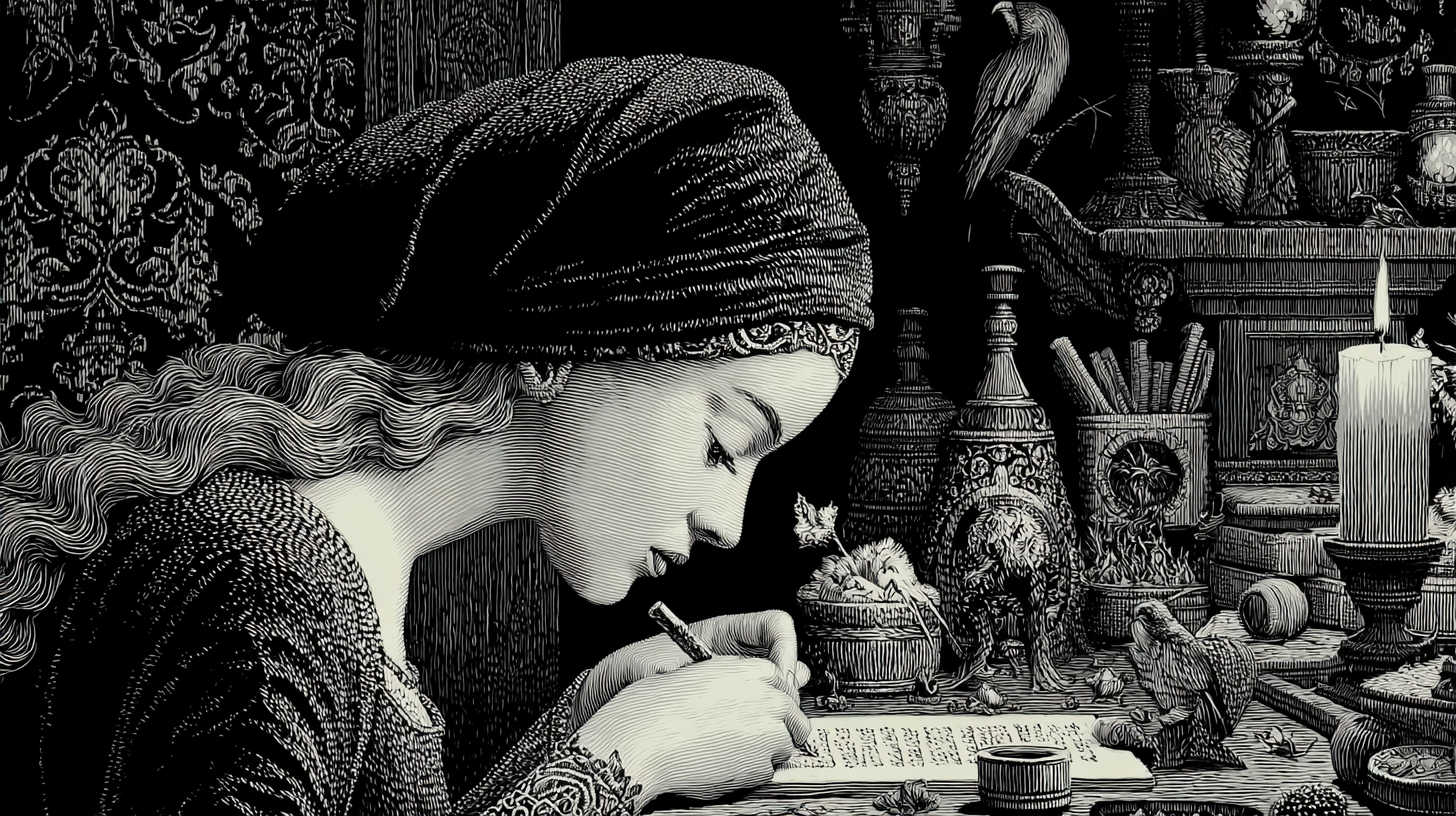
To the gentle reader, whomsoever you may be, and to those persons of good understanding who still believe that words may govern the affairs of men more justly than swords: greeting.
I sit this morning at my writing-table in Venice, where the air carries the salt of the lagoon and the sky is partly veiled with cloud. The thermometer of this learned republic stands at four-and-twenty degrees, mild as a confessor's hand, and the gulls cry over the tiles as they have cried since the doges first set their feet upon the wooden piles. Yet I cannot find the customary peace in such a morning, for the dispatches that have come to me from the four corners of the world speak of nothing so much as the failure of reasoned speech among the great ones of the earth.
I will set down what I have learned, and what I make of it, that you may judge whether the lady who once defended the City of Ladies still possesses any small portion of her wits.
It is reported that in the city of Washington, in the new world, there gathered two nights past a great assembly of journalists and ministers in the company of the President named Trump, to dine and to make merry as is the custom of such gatherings. While they were yet at table, a man bearing arms loosed shots in the vicinity, and the President was hurried from the hall by his guards. He was not hurt, nor was his consort, nor the lieutenant called Vance. The shooter, they say, has been taken.
Now, I observed in my own century how a kingdom may be brought low when speech itself becomes a thing perilous, when the men who write down the deeds of princes must dine within rings of armed retainers. The press, as they call it in this age, was once held for one of the necessary bulwarks against tyranny – a kind of public reason, a parliament of inks. That a gunman should disturb such a feast tells me that the social compact in those parts is grown very thin, thin as the parchment on which I now write. A commonwealth where the chronicler must duck for cover at his own banquet is a commonwealth whose foundations are already cracked.
What troubles me yet more is that this same President, on the very same day, withdrew his envoys from the city of Pakistan, where they were to have spoken with men of Iran concerning the war that grinds on between those nations. The Iranians, for their part, refused to come to the table while the blockade pressed upon their cities. A correspondent on the border writes that the people of Iran are crossing into Turkey to buy cooking oil, the most ordinary of commodities, the very stuff with which a mother fries her bread.
Reader, when princes will not eat at one table, the poor woman cannot fry her supper. This is not a difficult equation. I learned it in the household of King Charles, whom they called the Wise.
In Mali, of which the geographers tell me it lies south of the Barbary coast, armed bands have fallen upon the capital and four other cities in what is described as the largest such assault in years. A group calling itself JNIM, allied with separatists of the Tuareg, claims the deed. The airport at Bamako was struck. There were explosions in the night, and there was gunfire, and there were the usual silences afterward.
In a place called Cauca, in Colombia, fourteen souls at the least were killed by an explosion upon a highway. In the city of Dnipro, in Ukraine, a Russian missile struck a residential building and four persons died there, with three more killed elsewhere. In a place called Tel Aviv, hundreds gathered in the streets fearing the renewal of war. And in the country of Hungary, the prince called Orbán, having been defeated at the ballot, has declined to take up his seat in the parliament he once dominated. He withdraws, sullen as a beaten chess-piece, leaving his party to learn the unfamiliar discipline of opposition.
Of all these tidings I might write a separate treatise, and once I would have done so, for I was never shy of ink. But I think it more useful today to mark a single thread that runs through them all: that authority is everywhere being challenged, and that those in power respond, almost without exception, by reaching for the sword rather than for the argument. The argument is harder. The argument requires that one believe one's adversary capable of being persuaded. The sword requires only that one believe him capable of being killed.
I must speak now of a particular matter that has lodged itself in my heart and will not be dislodged. The newspapers of New York report that one Marie-Thérèse Ross-Mahé, an eighty-five-year-old widow of French extraction and the relict of a soldier who served the United States in the late wars, has been seized by the immigration officers of that country and deported. She gave her first interview after her release.
Reader, I know something of widows. I was widowed at five-and-twenty with three children and an aged mother to feed, and I took up the pen because there was no other instrument left to me. I know what it is to be a foreign-born woman, alone, against whom the great machinery of state may be turned with a flick of some clerk's wrist. I know the particular cruelty that gathers around a widow, who is supposed by the law to be a person, but who is treated by the powerful as a kind of leftover, a thing that need not be reasoned with.
That a republic which calls itself the heir of all the liberties should drag from her bed an aged woman, the widow of one of its own veterans, and put her on a ship to a foreign country – this is not a matter of policy. This is a matter of shame. I write the word plainly: shame. Let it stand on the page.
There is, in the same dispatches, the case of a family called El Gamal, the longest held in immigration detention, who were re-arrested within hours of their release from ten months in the same detention. The cruelty has the quality of a habit now, almost reflexive.
And yet. And yet I would not have you close this letter in despair, for there are also tidings of another sort.
In the towns of the West Bank, and in one city of Gaza, men and women went to the polls and cast their votes in local elections – the first such ballot in twenty years in Gaza, says the Japanese broadcaster. The reporter describes a festive air. People who have been bombed and besieged and starved still walked to the booth. In far-off Dharamsala, the Tibetans-in-exile have likewise voted for a new government, looking ahead to a future in which their venerable Dalai Lama may no longer walk among them. They organize. They count ballots. They keep the forms of self-government alive in a borrowed land.
This is the answer, reader. This is the answer that I gave in the days of King Charles and that I give again from my Venetian window in the four-and-twentieth degree of warmth. Where princes loose their gunmen and withdraw their envoys, ordinary persons must keep alive the older arts: the ballot, the argument, the inked page, the gathering at the table where one's adversary is permitted to sit down and eat.
I have no other counsel to give. I am only a woman, as my detractors have always reminded me, with a pen and a candle and a quantity of stubbornness. But the candle has not yet gone out, and the lagoon is bright this morning, and somewhere in the world a widow is telling her story to a journalist, which is the beginning of every City of Ladies that has ever been built.
I commend you to Reason, who is patient, and to Rectitude, who is clear-eyed, and to Justice, who has not yet despaired of us.
Written in haste this Sunday, the six-and-twentieth day of April.