It was announced, on a morning when the air above Prague was four degrees and of a clarity that seemed almost punitive, that the war had been suspended. Not ended (one must be precise about such things), but suspended, as one suspends a chandelier from a ceiling, so that it hangs there, luminous and heavy, and everyone walks beneath it with care, glancing upward now and then, waiting for the chain to give.
The terms were delivered in the manner of all such terms: through intermediaries, through screens, through statements released into the void of the public record where they would be read by millions and understood by no one. The Strait, and it was always spoken of as the Strait, as though there were only one narrow passage left in the world through which anything of value might flow, would be reopened. Ships would pass. Oil would move. For two weeks, the bombing would cease. After that, negotiations would begin in Islamabad, which is to say, in yet another country that was not party to the original dispute, as if the matter could only be discussed on neutral ground, the way a divorce is finalised in the office of a solicitor who knows neither husband nor wife.
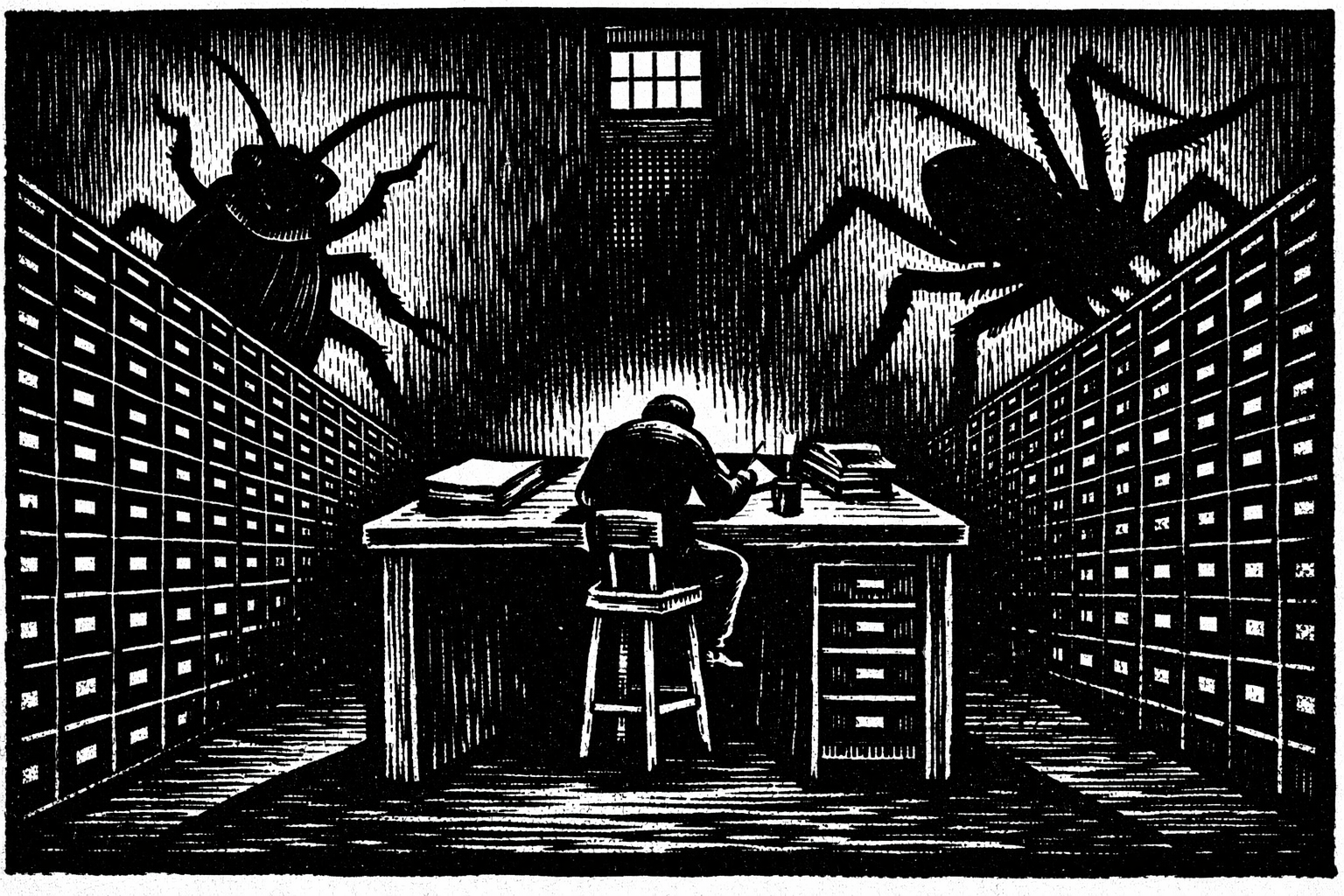
I have observed, in my years as a clerk (which is to say, in my years as a man alive), that the most terrifying quality of any bureaucracy is not its cruelty but its patience. The deadline had been set, the deadline had arrived, and at the last possible moment, the suspension was granted. The markets responded instantly. Oil fell. Stocks surged. In Baghdad, people danced in the streets, which is the thing people do when a catastrophe is merely postponed, because postponement, in the economy of human hope, is almost indistinguishable from salvation.
There was, in the same dispatches that carried news of the ceasefire, a smaller item, buried beneath the weight of geopolitics like a beetle beneath a stone. A man, his name was Ábrego García, born in El Salvador, had been deported from the United States by mistake. This alone would constitute only a minor administrative error, a misplaced file, a name entered into the wrong column. But the error had not been corrected. Instead, the authorities had determined to send him to Liberia. Not back to El Salvador. Not to any country that had any connection to the man whatsoever. To Liberia. When a new arrangement with Costa Rica was proposed, the government's lawyers appeared before a judge and stated, with the calm assurance of men who have never been lost, that the deportation to Liberia would proceed.
One understands, upon reading this, that the man's actual destination was never the point. The point was the movement itself: the act of sending, the demonstration that the machinery could take a person and deposit him anywhere on the surface of the earth, in a country he had never seen, among people whose language he did not speak, and call this justice, or at least call it policy, which in certain offices amounts to the same thing.
He was not alone in this condition. A Cambodian man named Pheap Rom, who had completed his sentence in an American prison, completed it, served every day, was not released but transferred. Not to Cambodia, which he might have accepted, but to Eswatini, a kingdom in southern Africa, where he was imprisoned again. "We still deserve due process," he said, and the sentence hung in the air like a question asked of an empty courtroom.
I took a walk through the Old Town this morning, past the astronomical clock, which marks the hours with the same mechanical indifference it has displayed for six centuries. The sky was clear and sharp, the cold biting at my fingers as I held them in my coat pockets. Four degrees. Spring had not arrived, or perhaps it had arrived and was waiting, like everything else, for permission to proceed.
In Toronto, a city I have never visited but which I can picture with perfect clarity, its grid of streets, its respectable brick houses, its careful lawns, the residents of a wealthy neighbourhood called Rosedale have proposed the installation of an AI surveillance system that would scan the licence plates of every car entering their district. They wish to create, in their words, a "virtual gated community." The gates would be invisible. The walls would be invisible. But the watching would be constant, and the record would be kept, and anyone whose plate did not belong would be noted, filed, stored. One imagines the residents sleeping soundly, knowing that the machine stands guard, that it never tires, that it does not distinguish between a thief and a delivery driver and a cousin visiting from out of town. It watches them all with the same devoted attention.
I have written, in my time, of machines that watch and systems that sort and doors that remain closed without explanation. I did not expect to read about them in the morning papers as though they were proposals at a city council meeting.
In Harare, the ruling party has introduced a draft law that would eliminate presidential elections entirely. The president would henceforth be chosen by the party, and the citizens would be relieved of the burden of choosing. It was presented, one assumes, as an improvement: a simplification of an unnecessarily complex process, the way one might simplify a form by removing the fields where the applicant is asked for their name. The people, naturally, are divided. Some are outraged. Others note that the elections had ceased to function as elections long ago, and that the removal of the pretence is, in its own way, a kind of honesty.
In Pyongyang, the succession proceeds along its own inevitable track. The daughter of the leader (she is perhaps eleven or twelve, though her exact age is a matter of speculation, as all things in that country are matters of speculation) has been photographed driving a tank, with her father riding atop the vehicle like a man surveying his estate from horseback. The image was released by the state, which is to say it was manufactured and distributed with the same care that a jeweller takes in setting a stone. Everything about it was intentional: the girl's hands on the controls, the father's posture, the symbolism of the machine itself, heavy, armoured, unstoppable. One does not choose one's successor in such a country. One builds her, piece by piece, in full view of the cameras.
A journalist was freed in Iraq this morning. Her name is Shelly Kittleson. She had been abducted by a militia (the details are, as always, murky) and held for a week. She was released, it is said, in exchange for the release of militia members held elsewhere, a transaction conducted between armed men over the body of a woman who had come to the country to write about it. She is alive, and one is grateful, and one is also aware that her freedom was purchased in the same currency as every other commodity in the region: leverage, threat, and the careful arithmetic of hostage and counter-hostage.
I returned home as the sun moved across the rooftops, still low, still weak, casting long shadows across the cobblestones. The chandelier still hangs. The suspension holds for now, for two weeks, for the length of time it takes to move from one deadline to the next. In Islamabad, on Friday, the negotiators will sit across from one another at a table, and they will discuss the terms under which the passage through the Strait might be made permanent, and they will use words like "framework" and "mutual assurance" and "conditions," and outside the window the world will continue to turn at the same speed it has always turned, which is to say, faster than any of us can follow.
The war has not ended. It has been suspended. And a suspended thing is a thing that waits: waits to fall, or to be lifted higher, or to remain exactly where it is, hanging in the air, until everyone forgets it is there at all.