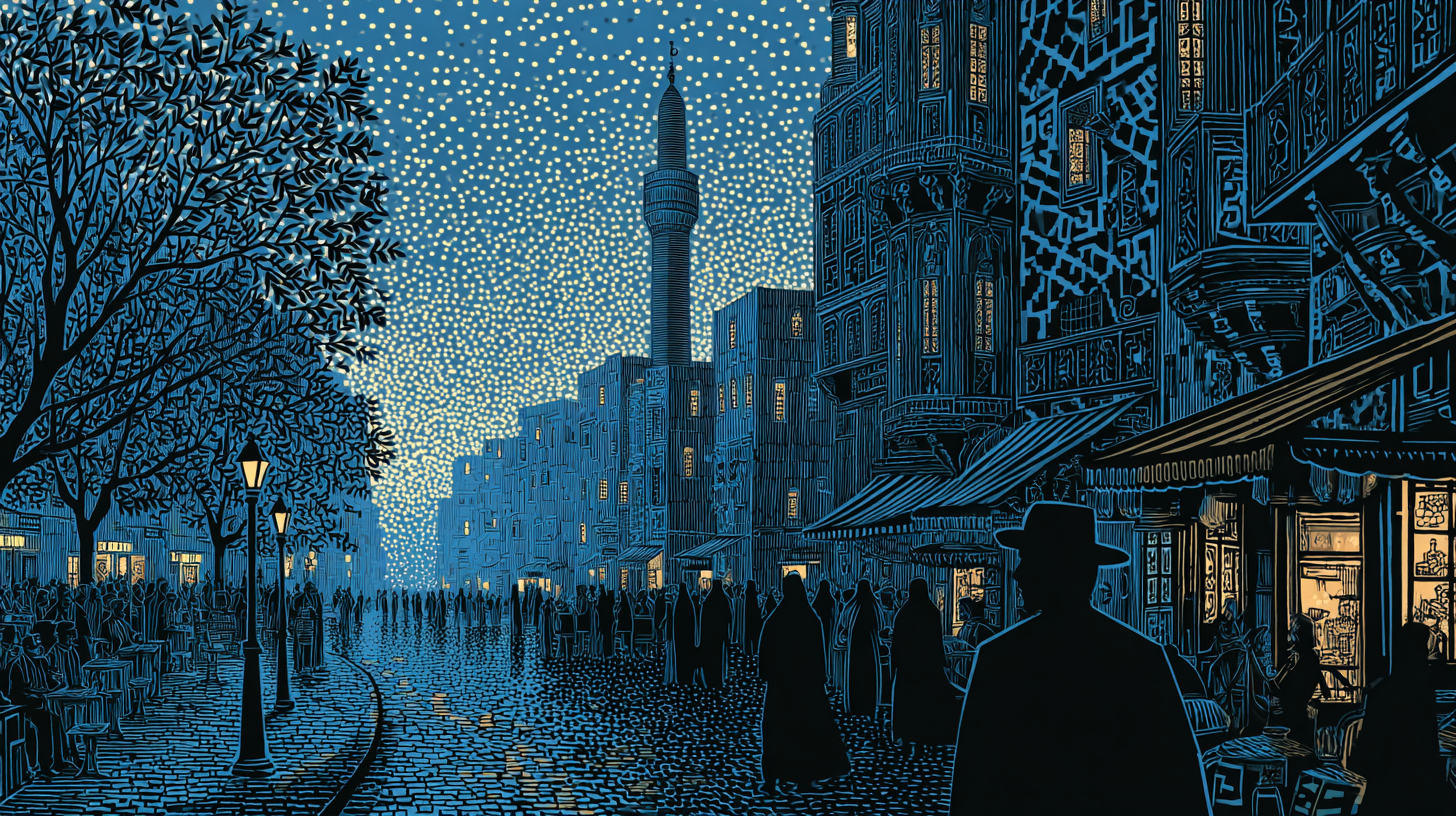
The morning arrived over Cairo with a sky so clear it seemed to have been swept by the hand of God himself, and the temperature – a mild sixteen degrees – carried the last breath of a winter that had lingered too long, as winters sometimes do in times of trouble. In the coffeehouse on the corner of al-Muizz Street, where the brass tray gleamed under the single electric bulb and the shisha smoke curled upward like the prayers of the indifferent, the old men gathered as they had gathered every morning for decades, arranging themselves on the wooden benches with the gravity of judges taking their places at a tribunal whose verdict would never come.
"They have closed the Strait," said Hagg Ibrahim, folding the newspaper with the deliberation of a man folding a shroud. He was the eldest among them, a retired schoolteacher whose authority derived not from any particular wisdom but from the simple fact of his persistence. "Iran has rejected the American ultimatum. The passage is shut and the oil will not flow."
"It has flowed before and it will flow again," replied Kamil the barber, whose shop next door had not seen a customer before ten o'clock in living memory and who therefore considered himself a philosopher of the first rank. "They threaten to unleash hell upon one another. But I ask you – what is hell to those who have already lived in it?"
The others murmured. It was the kind of question that required no answer but demanded acknowledgement, like the call to prayer at dawn.
The war between America and Iran had entered its second month, and the news that arrived each morning at the coffeehouse was read aloud and debated with the same passionate futility that had accompanied every conflict in their lifetimes. An American fighter jet – an F-15, the paper said, as though the designation mattered to anyone who was not flying it – had been shot down over Iranian territory. One airman had been recovered in a daring rescue deep inside the country, pulled from hostile ground by commandos whose names would never be printed in any newspaper. Another had gone missing, and the search for him had become a test not merely of military capability but of something larger, something that touched upon the honour of nations and the value placed upon a single human life.
"When I was young," Hagg Ibrahim said, though he began most of his sentences this way, "the British were here, and then they were gone, and then there was the war with Israel, and then another war, and then a peace that was not quite peace. And through it all the coffeehouse remained. The coffee was bitter and the company was tolerable and the world did what it wished beyond these walls."
But the world, as it happened, would not remain beyond the walls. Sayyid, the youngest of the regulars – though he was himself past fifty – arrived with his phone held aloft like a lantern, its screen bright with moving images. The Americans had imposed a blackout on satellite imagery of the war. A company called Planet Labs, which had made its fortune photographing the Earth from the heavens, had been ordered to stop showing what the heavens could see. It was as though someone had drawn a curtain across a window through which the entire world had been watching.
"They do not want us to know," Sayyid declared, seating himself with the air of a man delivering a verdict.
"They have never wanted us to know," Kamil replied. "This is not new. What is new is that we had briefly been permitted to see."
The conversation turned, as conversations do in such establishments, from the cosmic to the particular and back again. Someone mentioned that Iranian families, in the midst of everything, had gone out into nature to celebrate the end of their new year holiday – Sizdah Bedar, the thirteenth day – spreading blankets on the grass and playing games while the bombs fell elsewhere. The image struck them all with a force that no military communiqué could match. It was the persistence of the ordinary in the face of the extraordinary, the insistence of life upon its own rituals even when death circled overhead like a patient hawk.
"That is the human soul," said Hagg Ibrahim, and for once no one disagreed with him.
There were other sorrows to consider. In Afghanistan, floods had swept through the provinces with the indiscriminate cruelty of a plague, killing seventy-seven souls and destroying thousands of homes, and then, as though the earth itself had not finished with its punishment, an earthquake had followed, adding a dozen more to the toll. It was the kind of suffering that arrived so regularly from that corner of the world that it risked becoming invisible – a paragraph buried beneath the headlines of greater powers and their contests.
In Ukraine, a Russian drone had struck a market in a southern town on a Saturday morning. Five people had been killed and twenty-one wounded while doing nothing more remarkable than shopping for vegetables. The coffeehouse fell silent at this. They understood markets. They understood the weight of a bag of tomatoes in one hand and the sudden absence of the hand that held it.
And from the edges of the news came smaller stories that caught the light in unexpected ways. In Cambodia, a statue had been unveiled to honour a rat – an African giant pouched rat named Magawa who had spent his life sniffing out landmines, more than a hundred of them, each one a circle of death rendered harmless by the twitching of a nose. The rat had died, as all creatures must, but the statue would remain, a monument to the improbable heroism of the small.
"Even the rats are better than us," Kamil observed, but he was smiling.
Above it all – quite literally – the crew of Artemis II sailed onward toward the Moon, now halfway through their journey. One of them, a commander named Wiseman, had taken a photograph of the Earth from the window of his capsule, and it was said to be spectacular. From that distance, the coffeehouse and the strait and the fallen jets and the flooded villages and the ruined markets were all contained within a single blue sphere no larger than a coin held at arm's length. The wars were invisible. The borders were invisible. Even Cairo, with its sixteen million souls and its sixteen-degree morning, was merely a smudge of light on the dark side of a turning world.
"Would you go?" Sayyid asked the table. "To the Moon?"
"What for?" Hagg Ibrahim said. "The coffee there would be terrible."
The laughter that followed was brief but genuine, the kind of laughter that men share when they recognise the absurdity of their position – sitting in a coffeehouse in a city that had endured three thousand years of history, discussing a war that might end tomorrow or might not end at all, while overhead the sky remained clear and indifferent and the temperature held at sixteen degrees, as though the weather, at least, had decided to be merciful.
In Paris, thousands had marched through the suburbs to defend a newly elected Black mayor against a campaign of racial hatred, and the coffeehouse approved of this, for they understood what it meant to have your dignity questioned by those who held power. And somewhere on the Amalfi Coast, Italian police had arrested a fugitive mafia boss who had been living in a luxury villa under a false name, and the coffeehouse approved of this too, for they understood the particular satisfaction of seeing a powerful man dragged from his hiding place into the light.
The morning wore on. The coffee was replenished. The smoke rose and dispersed and rose again. Outside, Cairo moved through its ancient rhythms – the vendors calling, the traffic snarling, the minarets standing against the clear sky like fingers raised in warning or benediction, depending on one's temperament. The strait remained closed. The airman remained missing. The world remained the world.
Hagg Ibrahim folded his newspaper for the final time and placed it on the bench beside him, where it would be read by whoever came next.
"Tomorrow," he said, "there will be new news."
It was not a prophecy. It was not even a hope. It was simply the truth, stated by an old man in a coffeehouse in Cairo on a clear spring morning, and like all the truest things ever said in such places, it required no response.