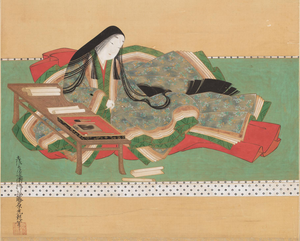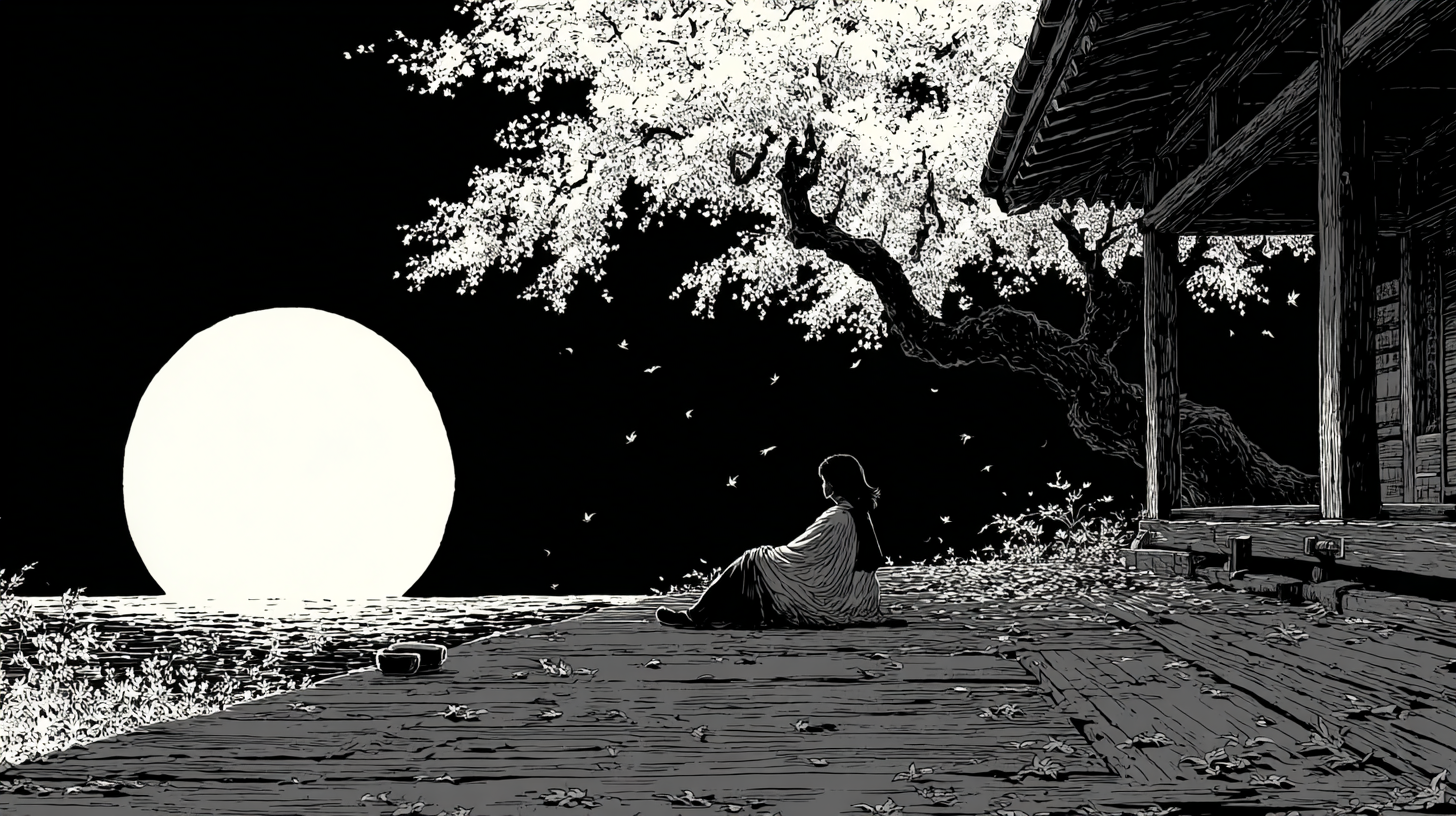
It is the third day of the fourth month, and in Kyoto the sun falls upon the old wooden eaves with a warmth that seems almost improper for the season – eighteen degrees, the servants murmur, as though the weather itself has grown impatient with propriety. The cherry blossoms have already opened along the Kamo River, and one cannot help but feel, watching their petals tremble in the light, that beauty has once again arrived before we were prepared to receive it.
Word has reached us from the far shores of the western lands that a vessel carrying four souls has broken free of the earth's embrace and set its course toward the moon. They call it Artemis, after a goddess of the hunt, which strikes this writer as a curious name for so gentle an undertaking. Not since the time of a previous such journey, some fifty years ago by the scholars' reckoning, have human beings ventured beyond the familiar orbit of our world. One thinks of the Shining Prince Genji himself, who was forever drawn toward what lay beyond the next screen, the next mountain, the next impossible longing. The moon has always been the confidant of those who cannot sleep for wanting what they do not have. And now, at last, someone has decided to go and see whether the moon has anything to say in return.
Yet even as these travellers rise, the earth beneath them darkens with sorrows that no distance can diminish. In the ancient lands of Persia, where poets once composed verses of such piercing beauty that they could make a stone weep, the great bridge at Karaj has been struck down by those who wage war from above. They say a hundred souls were harmed – people who were merely crossing from one side of their lives to the other, as people do, as people have always done. The lord of the western realm boasts that he will reduce this civilization to rubble, and one wonders whether he has ever read Ferdowsi, or whether he knows that the stones he destroys were laid by hands that understood eternity far better than his own.
The warfare has shuttered Iran's two largest steel plants, and the tremors of this violence ripple outward like a stone cast into the waters of a still pond. The price of oil climbs, and with it the cost of all those ordinary things: the fuel that carries goods to market, the bottles that hold water and medicine. In India, the makers of glass and plastic vessels find themselves unable to procure the raw materials they need, and so even the humble beer bottle becomes entangled in the threads of distant conflict. At the Strait of Hormuz, where trade has flowed for centuries like blood through a vein, the passage grows ever more uncertain, and the lords of forty nations gather in council to deliberate over what is to be done. One thinks of the political intrigues at the Heian court, where ministers would spend entire seasons debating the proper colour of a ceremonial sash, but at least those deliberations rarely ended in fire.
In Rome, the new pontiff (they call him Pope Leo) has performed the ancient rite of washing the feet of twelve priests, bending low before them in a gesture of humility that would have been well understood at our own court, where the highest-born must occasionally kneel before the lowest to prove that rank is merely a garment and not the skin beneath. His predecessor, it is said, chose prisoners and refugees for this ritual. The new lord of that faith has returned to an older custom, but he spoke words that cut through ceremony like a blade through silk: he condemned the brutality of the world, urging those who follow his teachings to stand with the oppressed. It is a fine thing to say, and one hopes it is not merely said.
In a quieter corner of the world's affairs, a tale has emerged that would make even the most cynical lady-in-waiting smile behind her fan. In Brazil, the lawmakers have decreed that when a couple separates, their pets shall be granted joint custody, shared between two households like a child of noble birth passed between rival clans. It is a small law, perhaps, but it speaks to something true: that love attaches itself to living things without consulting our legal arrangements, and that the bonds we form with those who cannot speak our language are sometimes the most honest bonds we know.
From the northern lands of Europe comes news of a different kind of care. The officials of that great union of nations have turned their attention to the world within the glowing screens, those luminous rectangles that now occupy every hand and every hour, and have begun to devise protections for children who wander there. They wish to make the invisible pathways less addictive, less predatory, less designed to harvest the attention of the young like silkworms stripped of their cocoons. It is the sort of concern that a mother at the Heian court would have understood perfectly, for we too worried about the influences that might reach our children through poetry, through music, through the whispered stories of visiting monks.
And then there is this: in the Netherlands, a golden helmet of extraordinary antiquity has been recovered, more than a year after it was stolen from its resting place. Three golden bracelets were taken alongside it, and all but one have now been returned. One imagines the helmet sitting in some thief's quarters, gleaming in the half-light, a thing so old and so beautiful that it must have made its captor feel, if only for a moment, the full weight of the centuries pressing down upon his unworthy hands. Beauty has a way of outlasting those who try to possess it. The bracelet that remains missing will, I suspect, find its way home eventually. Stolen things always do – it is only borrowed happiness that vanishes without a trace.
The sun has shifted now, and the shadows in my writing room have grown long. Beyond the latticed windows, the cherry blossoms continue their slow, inevitable surrender to the wind. In a few days they will be gone, and the trees will be ordinary again, and we will all pretend that we are not heartbroken by their leaving. But for now, on this warm and luminous afternoon, everything is still in flower.
The astronauts climb toward the moon. The bridges fall. The golden helmet returns to its glass case. The pets of Brazil are loved by two households instead of one. And somewhere in Persia, in the ruins of a steel mill, a worker picks through the rubble and remembers what stood there yesterday.
This is the nature of the world: always arriving, always departing, never the same river twice. One can only watch, and write it down, and trust that someone, someday, will read these words and feel what we felt, here, on this third day of the fourth month, when the sun was warm and the blossoms were still holding on.