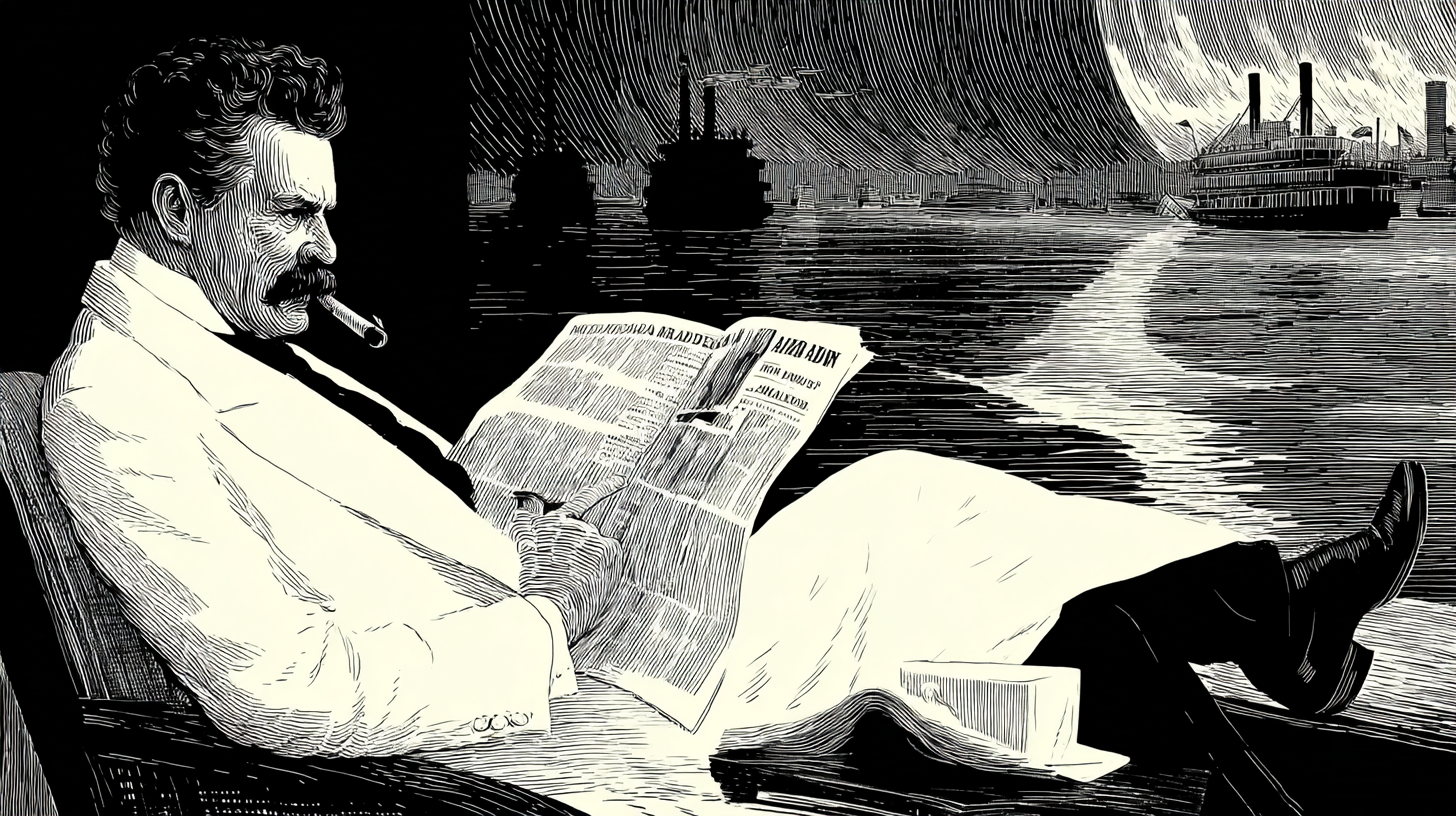
It is a clear spring day in Hannibal, Missouri – fourteen degrees on the Celsius scale, which is a European way of saying that a man can sit on his porch without a coat and reflect upon the stupidity of his fellow creatures in tolerable comfort. The sky is blue and honest, which puts it at a considerable disadvantage in the present company of nations.
I have been reading the newspapers, which is an exercise I recommend only to those whose faith in humanity was already in a condition past saving. The great powers of the earth are at war again – or rather, they have continued the war they were already conducting, having found no satisfactory reason to stop. Oil has climbed to a hundred and sixteen dollars a barrel, which is a price that would have made old John D. Rockefeller weep with joy, though he would have had the decency to weep in private. The Strait of Hormuz is blockaded, or half-blockaded, or blockaded on Tuesdays and Thursdays. The arrangement seems to shift according to which official is speaking and how recently he has had his lunch.
The President of the United States has declared that Iran has permitted twenty additional oil tankers to pass through, and he has characterized this as a "sign of respect." Now, I have owned dogs who showed me signs of respect, and what they chiefly meant by it was that they wished to be fed. I suspect the transaction is of a similar character. Meanwhile, Iran continues to fire missiles at aluminium plants in the Gulf states and has damaged a power and desalination facility in Kuwait, killing an Indian worker in the process – a man who had presumably traveled a great distance from home to earn a living and did not expect to be blown up for his trouble. That is the difficulty with earning a living; it so often interferes with staying alive.
The President has further suggested he might seize Iran's Kharg Island, which produces most of their oil. If there is one thing history teaches us, it is that nothing calms a war like announcing your intention to steal the other fellow's property. I learned that principle early on the Mississippi, where it was practiced by river pirates, though they had the advantage of operating on a smaller scale and without press conferences.
In Paris, three persons have been arrested for attempting to detonate a bomb outside a Bank of America branch. The French anti-terrorism authorities took over the investigation immediately, which is the sort of decisive action governments excel at after the thing has already nearly happened. I confess I do not understand the logic of bombing a bank. If a man wishes to destroy a financial institution, he need only deposit his money in it and wait.
Speaking of financial matters, the Canadians have elected a new leader for their left-leaning party, a Mr. Avi Lewis, who is described as a "scion of a leftist political dynasty." The Canadians are a people I have always admired for their ability to conduct their politics at a temperature several degrees below exciting. Mr. Lewis intends to revitalise workers' rights, which is the sort of promise that sounds magnificent until one discovers it means filling out forms.
Meanwhile, two Australian states have taken the novel step of offering free public transport, on account of petrol prices being driven skyward by the war. This is what passes for revolutionary policy in the modern age: giving a man a free tram ride while the world burns. I do not say it is without merit. A man on a tram is at least not driving, and a man who is not driving is not swearing at other drivers, and a man who is not swearing is – well, he is probably reading the news on his telephone and swearing anyway, but at least he is seated.
The news from Italy provides a welcome change of subject, if not of character. Four masked men have broken into a museum in Parma and made off with paintings by Renoir, Cézanne, and Matisse. It is a heist of the old-fashioned variety – masks, nighttime, the whole romantic apparatus. I find I cannot entirely condemn it. There is something almost refreshing about criminals who steal beautiful things rather than ugly ones. Your modern thief steals data, or identities, or elections. These fellows stole art. If civilization must produce thieves, it might at least produce thieves with taste.
Also from Italy comes word that the government is investigating Sephora and Benefit (which I am told are cosmetics concerns) for marketing skincare products to children. The Italian authorities describe the strategies as "particularly insidious," which is a phrase I thought was reserved for tax collectors and life insurance salesmen. I did not know children required skincare. In my day, the skin of a child was maintained by dirt, sunshine, and the occasional involuntary bath. The results were perfectly satisfactory. But I suppose progress demands that we begin worrying about wrinkles before we have finished getting freckles.
In Seoul, in the district called Gangnam, which I understand to be the richest neighbourhood in the city, there exists a slum. Hundreds of people are living in shanties in the most expensive real estate on the Korean peninsula, refusing to be evicted, and fighting for the right to own a home in a place where homes cost more than some nations' treasuries. There is a parable in this that would have suited the Gospels, though the Gospels had the advantage of a more sympathetic audience. The poor have always lived beside the rich; what is new is that the rich have discovered this and found it inconvenient.
Across the Atlantic, large crowds have gathered in American cities to protest against the President. This is a tradition nearly as old as the presidency itself, and I am heartened to see it continues. The right to assemble in the street and shout at a man who cannot hear you is the very cornerstone of democracy. It accomplishes nothing, but it is excellent exercise, and it reassures the participants that they are not alone in their dissatisfaction, which is a comfort not to be underestimated in times such as these.
And in the waters near Cuba, a Russian oil tanker loaded with seven hundred and thirty thousand barrels of crude is steaming toward the island, with the apparent blessing of the American government, which has chosen to look the other direction. The President says he has "no problem" with Russia sending oil to Cuba, which is a remarkable statement from a man who has problems with nearly everything else. But consistency has never been the hobgoblin of the powerful; that particular affliction is reserved for the rest of us.
I sit on my porch in the clear air and consider whether the species has made any measurable progress since I left it. The evidence is not encouraging. We have better telephones and worse wars. We sell face cream to eight-year-olds and bomb desalination plants. We steal Renoirs in the night and seize oil fields in the daylight and call one a crime and the other foreign policy. The temperature is fourteen degrees, and the sky does not care, and the river (if I listen carefully enough) is still rolling along, as it always has, indifferent to the whole magnificent, maddening enterprise.
That, at least, has not changed. And I find it a considerable relief.