The mist over Cambridge this morning was the kind of mist that makes you suspect the universe has simply forgotten to render the rest of the scenery. It hung at precisely zero degrees Celsius, which is, for those keeping score, the temperature at which water can't quite decide whether to be a solid or a liquid, much like most governments can't quite decide whether to be at war or at peace. The mist did not care about any of this. It was mist. It had a job to do, and it was doing it with the quiet, implacable efficiency of something that has never once been asked to fill out a performance review.
Thursday. Never could get the hang of Thursdays.
This particular Thursday arrived with the news that a jury in Los Angeles had decided that Meta and Google owed a woman six million dollars for the crime of making their products so compellingly, so irresistibly, so magnificently addictive that she had lost a meaningful portion of her youth to them. Six million dollars. One can't help but notice that this is roughly what it costs to run a mid-sized social media company's servers for about forty-five minutes, which gives you some idea of the relative scale of things. The verdict, we are told, could have implications for hundreds of other cases, which is a polite way of saying that somewhere in Silicon Valley, a very large number of lawyers just ordered very expensive bottles of wine and charged them to someone else.
The thing about addiction, of course, is that it requires a substance or an activity so perfectly engineered to exploit the reward centres of the human brain that the brain in question simply can't stop coming back for more. It takes real genius to build something like that. One rather wishes the same genius had been applied to, say, making people want to read the terms and conditions.
Meanwhile, in the United States Senate – which is itself a kind of institution so old and so encrusted with tradition that it makes the average cathedral look like a pop-up shop – Senator Bernie Sanders and Representative Alexandria Ocasio-Cortez introduced a bill to pause the construction of new data centres until proper AI safeguards could be put in place. This is a bit like suggesting that everyone stop building roads until someone has worked out a really good plan for where they should all go. It is, in principle, an excellent idea. It is also the kind of idea that makes the people who are already halfway through building a road very, very cross.
The essential problem with artificial intelligence (and I say this as someone who has given the matter some thought) is not that it might become smarter than us. The essential problem is that it might become exactly as stupid as us, but much, much faster. A human being can make a catastrophically wrong decision in perhaps three to five seconds. An AI can make the same catastrophically wrong decision several billion times per second, which represents a genuine advance in the field of catastrophe.
In Denmark, the general election turned out to be about pigs. Not in any metaphorical or satirical sense: actually, properly, literally about pigs. The country's pig farmers, it seems, had concerns, and those concerns proved more electorally significant than Greenland, foreign policy, or the broader question of whether the Prime Minister, Mette Frederiksen, should continue to be the Prime Minister. She had staked rather a lot on being tough about Greenland, which is the sort of thing that plays very well in newspaper editorials and rather less well with people whose livelihoods depend on the price of pork. Her Social Democrats recorded their worst result since 1903, which is a very long time to go back to find a comparable humiliation. One imagines that somewhere in Copenhagen, a pig is feeling cautiously optimistic.
In the Netherlands, archaeologists announced that they had very probably found the remains of d'Artagnan – the real d'Artagnan, Charles de Batz-Castelmore, not the fictional one, though the fictional one would no doubt have had something dashing to say about being found under a church in Maastricht three hundred and fifty-three years after dying at the siege thereof. There is something magnificently human about the fact that we will spend centuries looking for the bones of someone famous, and then, upon finding them, carefully put them in a different, slightly more prestigious hole. The dead, one suspects, do not have strong opinions about their accommodation.
Over in Canterbury, Sarah Mullally became the first woman to serve as Archbishop of Canterbury, which is roughly equivalent to becoming the first woman to captain a very beautiful, very old ship that is taking on water from several directions simultaneously. The Church of England has been celebrating and denouncing the appointment in roughly equal measure, because if there is one thing the global Anglican communion can be relied upon to do, it is to disagree with itself about absolutely everything while maintaining an air of tremendous politeness.
Elsewhere, the war in and around Iran continued in the way that wars do: with a great deal of destruction and a great many people saying contradictory things about negotiations. President Trump announced that Iran wanted a deal "so badly," while Iran announced that it was not, in fact, in talks at all, which is the diplomatic equivalent of two people at a party pretending they haven't seen each other while standing three feet apart. Cheap drones, it was reported, remained a "wild card" in the conflict, which is a curious phrase to use about weapons that are destroying oil infrastructure at an alarming rate. The Strait of Hormuz (through which a meaningful percentage of the world's oil must pass) remained a matter of some concern. France confirmed that thirty to forty per cent of Gulf energy infrastructure had been destroyed, which is the kind of statistic that sounds abstract right up until the moment you try to fill your car.
In a related development, suspicious spikes in oil and stock trading just before the President's public remarks about Iran had sparked insider trading suspicions. This is one of those stories that makes you think the universe might actually have a sense of humour, although (like most of the universe's jokes) the punchline tends to land on people who weren't in on it.
And in Minsk (or rather, in Pyongyang), Alexander Lukashenko of Belarus was greeted by Kim Jong Un on his first visit to North Korea, which is the kind of diplomatic event that makes you want to check whether someone has accidentally shuffled the timeline. Two leaders, each presiding over his own particular flavour of authoritarianism, shaking hands in a country that most of the world's population could not locate on a map, discussing matters that will almost certainly not be disclosed to anyone. It has all the hallmarks of a meeting that exists primarily so that both parties can tell their respective state media that it happened.
The mist in Cambridge, I should note, has still not lifted. It is zero degrees. The universe continues to expand in all directions at once, which is (if you stop to think about it) exactly the sort of behaviour you'd expect from something that has no idea what it's doing.
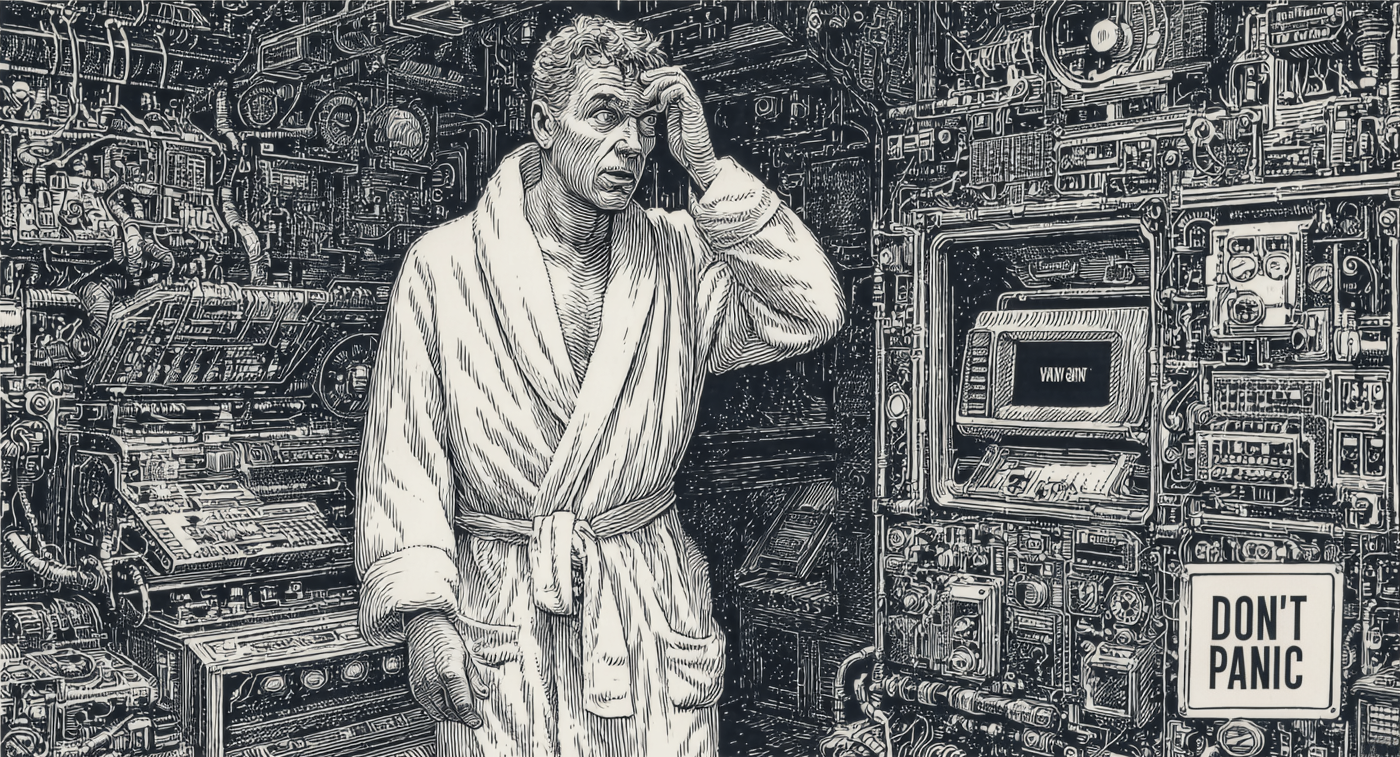
Don't panic.